

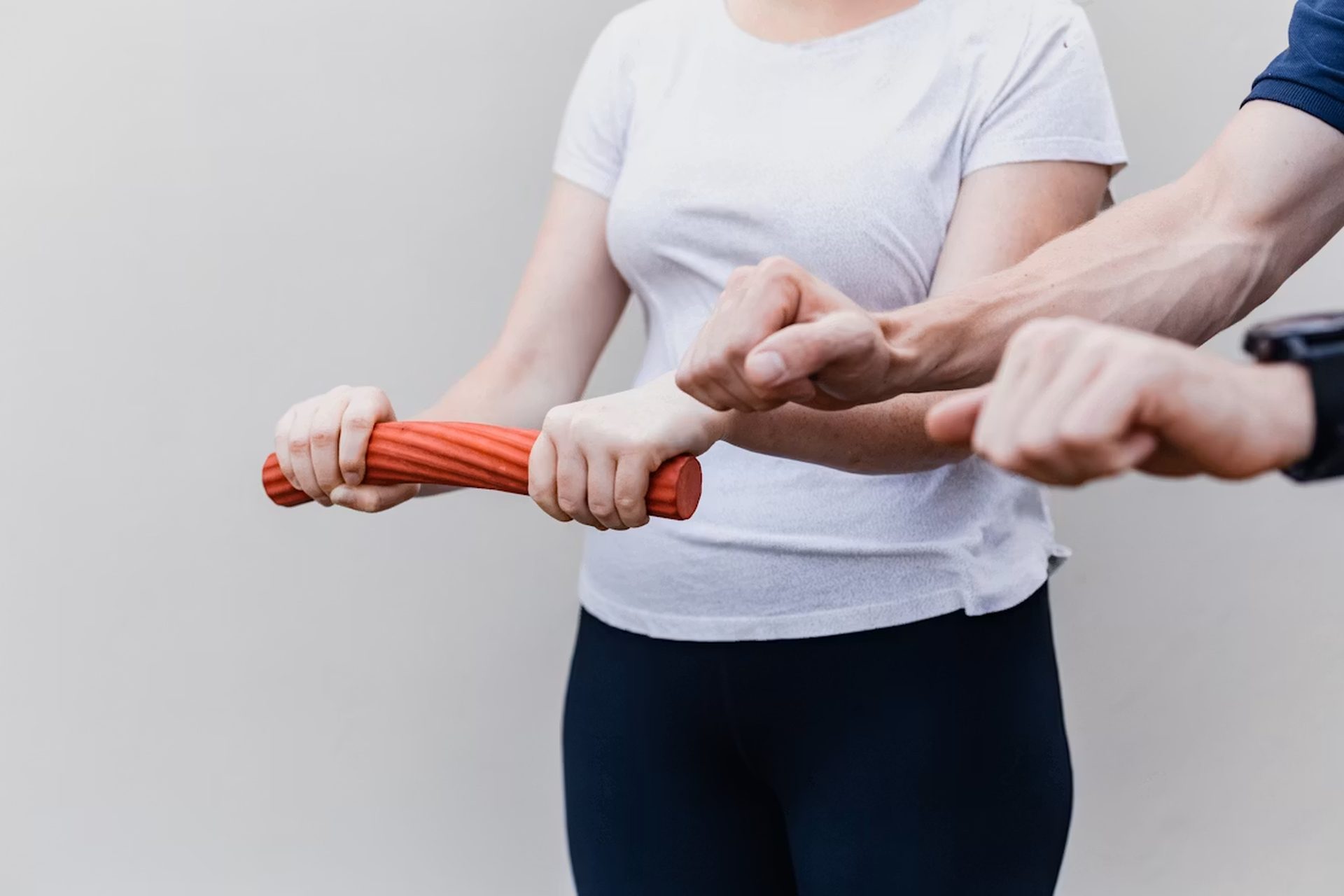
Why the pain sits on the inside of the elbow rather than the outside, why it has almost nothing to do with golf, why complete rest is usually the wrong instinct, and the progressive loading programme that rebuilds a sore flexor tendon back to a full grip — from a physiotherapist who treats elbow tendinopathy in clinic and at home.
Tennis elbow gets all the attention. Its quieter relative on the inside of the joint — golfer's elbow, or medial epicondylitis — produces a remarkably similar problem and responds to remarkably similar treatment, yet it is more often missed, mislabelled, or simply rested in the hope that it will fade on its own. It rarely does. The inner elbow becomes the new sore spot, gripping a kettle or a shopping bag sends a sharp twinge down the forearm, and the hand feels weaker than it should. Understanding what is actually happening in the tendon is the first step to fixing it.
The name is doubly misleading. Most people who develop golfer's elbow have never held a golf club, and the "-itis" suffix implies an inflammation that, in the chronic stage, is largely absent. What is really going on is a tendinopathy: a wearing-down and disorganised attempt at repair of the tendon that anchors the wrist and finger flexor muscles to the bony bump on the inside of the elbow. Naming it accurately matters, because it points the treatment in the right direction — away from anti-inflammatory thinking and towards a structured rebuild of the tendon.
What Golfer's Elbow Actually Is
On the inner side of the elbow sits the medial epicondyle, a small prominence of the humerus. From it springs the common flexor-pronator origin — the shared tendon of the muscles that flex the wrist, curl the fingers, and turn the palm downwards (pronation). Every time you grip, twist a screwdriver, swing a racquet, throw, or lift a weight with the palm up, those muscles pull on that tendon. When the cumulative load outpaces the tendon's capacity to adapt, the collagen fibres at the origin begin to break down faster than the body can lay down healthy replacement. The result is microscopic disorganisation, a thickening of the tendon, and a pain that is provoked by exactly the movements that caused it: gripping, wrist flexion, and forearm rotation.
It is, in short, the mirror image of tennis elbow. Tennis elbow affects the extensor tendon on the outside of the elbow; golfer's elbow affects the flexor-pronator tendon on the inside. The mechanism — repetitive overload of a tendon that was never given enough recovery to keep pace — is the same, and so, importantly, is the rehabilitation.
Who Gets It, and Why It Is Not About Golf
Golfer's elbow is an overuse condition, and the overuse can come from almost anywhere the forearm flexors are repeatedly loaded. The list of people I see with it includes plumbers and carpenters, gym-goers who have ramped up their pulling and gripping work too quickly, climbers, throwers and racquet players, office workers whose desk setup loads the wrist for hours a day, new parents lifting a growing infant dozens of times daily, and yes, occasionally, an actual golfer. The common thread is not the sport — it is a rate of loading that exceeded the tendon's rate of adaptation, often after a sudden increase in activity, a change of equipment or technique, or a return to something after a long break.
Why Rest Alone Is the Wrong Instinct
The natural response to a sore tendon is to stop using it, and for a few days of severe pain that is reasonable. But prolonged rest is one of the main reasons golfer's elbow becomes a months-long problem. A tendon is living tissue that adapts to the load placed on it. Take all load away and it does not heal stronger — it becomes less tolerant, weaker, and more easily irritated by the ordinary demands of daily life. When the person eventually returns to their activity, the now-deconditioned tendon is overwhelmed again, and the cycle repeats. The evidence across tendinopathies is consistent on this point: the tendon needs the right kind of load, applied progressively, to reorganise and strengthen. The skill of rehabilitation is delivering enough load to stimulate adaptation without flaring the pain past the point of recovery.
The Loading Programme: How the Tendon Is Rebuilt
The backbone of golfer's elbow treatment is a graded strengthening programme for the wrist flexors and forearm pronators. It typically moves through stages, and the progression is guided by symptoms rather than the calendar:
- Isometric holds: static contractions of the wrist flexors against a fixed resistance, held for a number of seconds at a level that is challenging but does not sharply increase pain. These are used early because they load the tendon, build tolerance, and often calm pain in the short term.
- Slow, heavy resistance: controlled wrist-curl and pronation exercises performed slowly through both the lifting and lowering phases, with the weight increased gradually over weeks. This is the phase that drives the structural reorganisation of the tendon.
- Eccentric emphasis: deliberately slow lowering of the wrist from a flexed position, which loads the tendon in a lengthening contraction and is well supported for tendinopathy rehabilitation.
- Grip and functional loading: progressive gripping work and task-specific drills that rebuild the strength the hand actually needs for daily activities, sport, or work.
- Return to the provoking activity: a planned, gradual reintroduction of the sport or task that started the problem, rather than an all-or-nothing return.
A small amount of pain during these exercises is acceptable and expected; the rule of thumb is that discomfort should settle quickly afterwards and should not be worse the following morning. The programme works because it respects how tendons actually behave — they respond to consistent, progressive demand, not to rest and not to a single heroic session.
The Ulnar Nerve Question
The medial elbow is also where the ulnar nerve travels, in the groove behind the bony bump — the spot most people know as the "funny bone." In a meaningful proportion of golfer's elbow cases, the nerve is irritated alongside the tendon, producing tingling or numbness in the little and ring fingers, or a sense of weakness in the hand that is out of proportion to the elbow pain. This matters, because the treatment is not identical. Part of a thorough assessment is distinguishing tendon pain from nerve irritation, and where the nerve is involved, the plan includes nerve-gliding work, attention to elbow positioning during sleep and daily tasks, and care not to compress the area. Lumping every inner-elbow pain together as "just tendinitis" misses this, which is one reason a proper hands-on examination is worth the visit.
Manual Therapy, Bracing, and the Kinetic Chain
Loading is the core, but it is not the whole picture. Hands-on manual therapy to the forearm muscles and the elbow joint can reduce pain and improve the tolerance for the loading work, especially in the early irritable phase. A counterforce brace — the strap worn a little below the elbow — can offload the tendon origin during aggravating activities and give useful short-term relief, though it is an adjunct rather than a cure. And crucially, the elbow is rarely the whole story. Weakness or poor control at the shoulder and shoulder blade, a stiff or weak grip, and faulty technique in the sport or task all push extra load onto the flexor tendon. Addressing the whole kinetic chain — from the trunk and shoulder down to the wrist — is what stops the problem returning once the elbow itself has settled.
A Structured Rehabilitation Pathway
Golfer's elbow is not a one-week problem, and the people who recover fully are usually the ones who follow a staged plan rather than chasing quick fixes. The pathway most patients move through looks like this:
| Phase | Primary Goal | What the Patient Does |
|---|---|---|
| Weeks 1–2: Settle the irritation | Calm the most provocative pain, protect the tendon without going to complete rest, confirm whether the ulnar nerve is involved | Relative activity modification, isometric wrist-flexor holds, gentle manual therapy, counterforce brace for aggravating tasks |
| Weeks 2–6: Load the tendon | Begin the structural rebuild of the tendon with progressive resistance | Slow, heavy wrist curls and pronation work, eccentric lowering, gradual weight increases guided by symptoms |
| Weeks 6–12: Build strength & grip | Restore full grip strength and address shoulder, scapular and technique factors | Heavier loading, progressive gripping, kinetic-chain strengthening, sport- or work-specific drills |
| Weeks 12+: Return & maintain | Return to the provoking activity safely and keep the tendon resilient long term | Graded return to sport or work, ongoing twice-weekly maintenance loading, technique and load-management habits |
The timeframes are a guide, not a promise — an irritable tendon caught early may move faster, while a long-standing one that has been rested for months will take its time. The single most important detail is that the loading does not stop the moment the pain does. A tendon that has been rebuilt will hold up only if it is kept strong, which is why a light twice-weekly maintenance routine is the difference between a lasting recovery and a recurrence the next time activity ramps up.
What You Can Do for Yourself
Self-management is a large part of recovery in golfer's elbow, because the loading exercises are done at home far more often than in clinic. The most useful habits are doing the prescribed exercises consistently rather than intensely, modifying — not abandoning — the activities that provoke the pain, paying attention to grip size and equipment (a thicker handle often loads the flexors less), and resisting the temptation to test the elbow with a hard squeeze every day to "see if it is better." Tendons dislike spikes in load. Steady, progressive demand is what they reward.
When to Seek Help
Inner-elbow pain that has lasted more than a couple of weeks, pain that is interfering with work or sport, a noticeable loss of grip strength, tingling or numbness in the ring and little fingers, pain that wakes you at night, or a sore elbow that keeps returning every time you go back to your activity are all good reasons to be assessed. Earlier treatment generally means a faster recovery, both because the tendon is less degenerated and because the surrounding muscles have not yet weakened from months of guarding.
Book a Golfer's Elbow Assessment
At PhysioDanali, we treat golfer's elbow with a hands-on assessment that distinguishes tendon from nerve, a progressive loading programme tailored to your starting point, manual therapy to ease the early phase, and kinetic-chain and technique work that keeps the problem from coming back. We see patients in Voula, Glyfada, and Vouliagmeni, in clinic and at home. For more on our home-based work, see our at-home physiotherapy page and our chiropractic and manual therapy page.
If the inside of your elbow has started to complain every time you grip, lift, or turn your wrist, book an assessment session. The sooner the loading programme begins, the sooner your grip and your confidence come back.
Call PhysioDanali today to book your golfer's elbow assessment.
This article is informational and does not replace medical advice. Persistent or severe elbow pain, or any numbness and weakness in the hand, should be assessed by a qualified clinician.