
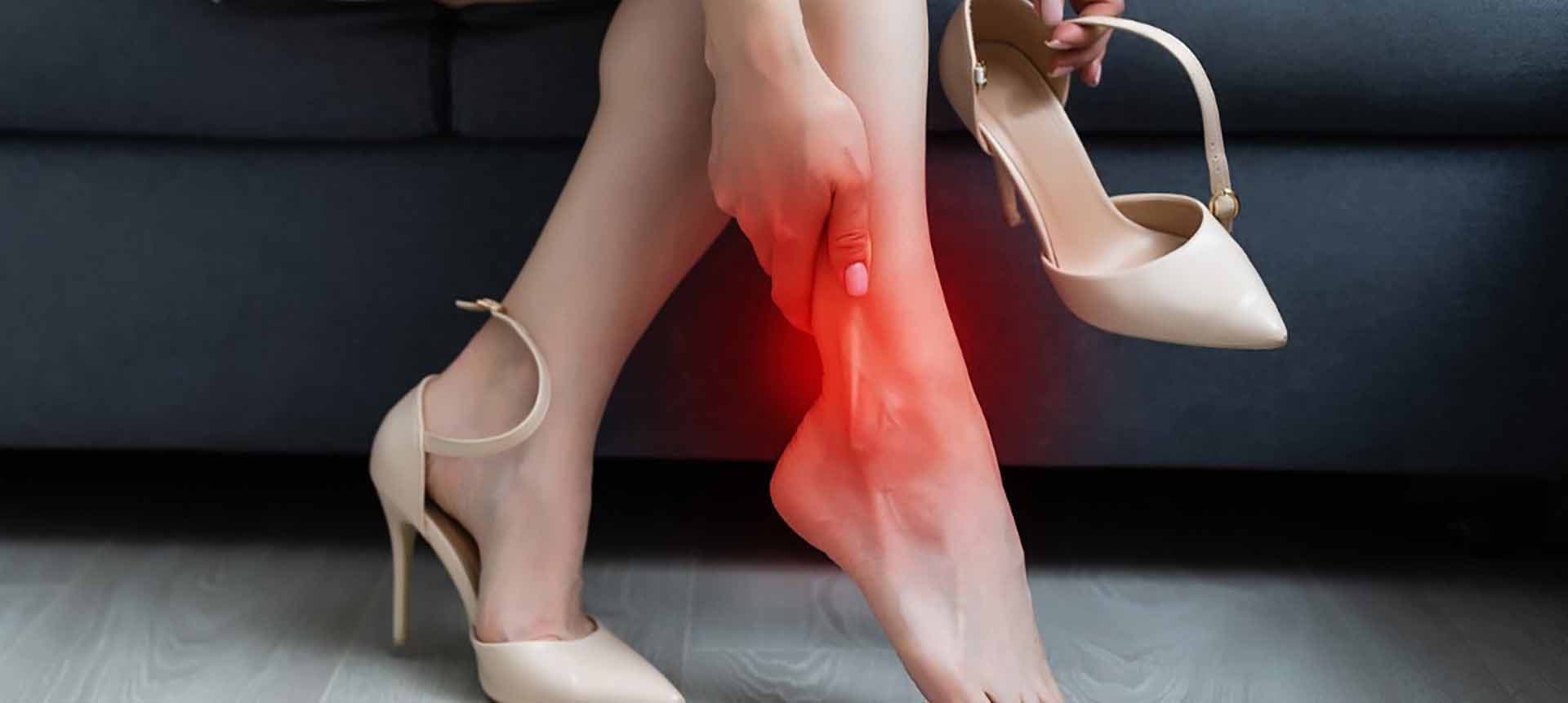
About Foot Pain
Foot pain is not always a simple matter. It may originate from any of the many structures that make up the foot, which include:
• Joints and articular cartilage
• Muscles
• Tendons
• Ligaments
• Bursae
• Joint capsules
• Bones
Persistent, intense pain often stems from two or more of the structures above, or from an injury.
Characteristics of Foot Pain
Foot pain can be mild with certain movements, or unbearable even at rest. For an accurate assessment, it is important to determine whether the pain is triggered by movement, by which specific movements, how long it takes to subside, or whether it persists at rest and for how long. It is also important to determine whether there is night pain and how long it lasts. Foot pain may have the following characteristics:
• Sharp
• Like a knife
• Like a blow
• Burning
• Like an electric current
• Superficial
• Deep
• Mild
• Dull
• Constant
• Intermittent
How is foot pain relieved?
When foot pain appears, the immediate measures we take are:
• Resting the foot and avoiding the activity that causes the pain
• Applying ice to the foot, over the painful area, for 15–20 minutes, 2–3 times a day (the ice should be wrapped in a towel)
• Resting with the foot elevated, on a chair or a pillow
• Gentle stretches of the hip, knee and sole, which maintain the foot's flexibility
Differential Assessment for Foot Pain
Assessment by the Physiotherapist is essential in order to identify the structures affected and to rule out, or not, the co-existence of other pathological conditions that present with similar symptoms, such as:
• Heel spur, Plantar Fasciitis
• Achilles Tendinopathy
• Fractures of the Foot
• Ankle Sprain
• Tendinopathies of the Foot
The assessment by Orthopaedic Manual Physiotherapist Mr. Konstantinos Danalis is carried out through a detailed medical history, the performance of clinical tests and the trial treatment that follows.
How does Physiotherapy help with Foot Pain?
The priority is to reduce the pain, which in some patients can be extremely acute. This is achieved through a combination of treatment options, such as specialised massage and the application of electrotherapy, which will reduce the pain in every case. Mobilisation of the foot is then carried out with specialised exercises. Gradually, as movement increases, strengthening, balance and proprioception exercises are introduced. The interventions applied are:
• Stretches and stretching exercises to increase elasticity
• Dynamic stability and strengthening
• Orthopaedic Manual Physiotherapy to reduce pain and increase flexibility
• Electrophysical Agents such as diathermy, cryotherapy and electrotherapy, to reduce pain and inflammation
• TECAR for deep heating of the tissues and to speed up recovery
Schedule Your Appointment
Athanasia A.
Mr. Danalis is a true professional who gives the patient and their problem the attention they need. Most importantly, however, is the quality and effectiveness of the treatment, delivered in a way that is creative and, above all, productive. I recommend him without reservation.
Erifyli S.
Mr. Danalis knows his field very well and takes a personal, dedicated interest in his patients! He has a positive attitude and has helped me a great deal!! I trust him completely and recommend him without reservation.
Giota S.
He knows his field very well, spent a great deal of time on my problem and truly earned my trust! I will definitely recommend him!
How can I prevent Foot Pain?
To prevent foot pain in chronic conditions, a monthly programme is required that includes:
• Orthopaedic manual massage
• A structured exercise programme
You can find further advice on prevention and self-management by the patient in the links below:
• Recommendations for Patients by the American Physical Therapy Association
• Recommendations for Patients by the American Physical Therapy Association
• Recommendations for Patients by the American Physical Therapy Association
What is the cost of treatment?
The cost of treatment is not high. Usually 6 sessions are required, in which the treatment programme is adapted each time to the patient's current condition. Once the symptoms have subsided, a structured exercise programme is introduced to prevent any relapses. The programme is provided to the patient electronically so that they can follow it on their own, but there is also the option of online supervision at a low cost. The patient has the ongoing support and communication they need with the Physiotherapist in order to overcome any difficulties.
If you have Foot Pain, call PhysioDanali today for specialised advice from the Physiotherapist!
•
Woodley BL, Newsham-West RJ, Baxter GD. Chronic tendinopathy: effectiveness of eccentric exercise. Br J Sports Med. 2007 Apr;41(4):188-98; discussion 199. doi: 10.1136/bjsm.2006.029769. Epub 2006 Oct 24. PMID: 17062655; PMCID: PMC2658941.
•
Cook JL, Purdam CR. Is tendon pathology a continuum? A pathology model to explain the clinical presentation of load-induced tendinopathy. Br J Sports Med. 2009 Jun;43(6):409-16. doi: 10.1136/bjsm.2008.051193. Epub 2008 Sep 23. PMID: 18812414.
•
Khan KM, Cook JL, Maffulli N, Kannus P. Where is the pain coming from in tendinopathy? It may be biochemical, not only structural, in origin. Br J Sports Med. 2000 Apr;34(2):81-3. doi: 10.1136/bjsm.34.2.81. Erratum in: Br J Sports Med 2000 Aug;34(4):318. PMID: 10786860; PMCID: PMC1724184.
• www.physio-pedia.com
• Mayo Clinic. (2021). Plantar fasciitis. Mayo Clinic.
• American Physical Therapy Association. (2021). Plantar fasciitis.
• ChoosePT.com.
• Martin RL, Davenport TE, Reischl SF, McPoil TG, Matheson JW, Wukich DK, McDonough CM; American Physical Therapy Association. Heel pain-plantar fasciitis: revision 2014. J Orthop Sports Phys Ther. 2014 Nov;44(11):A1-33. doi: 10.2519/jospt.2014.0303. PMID: 25361863.